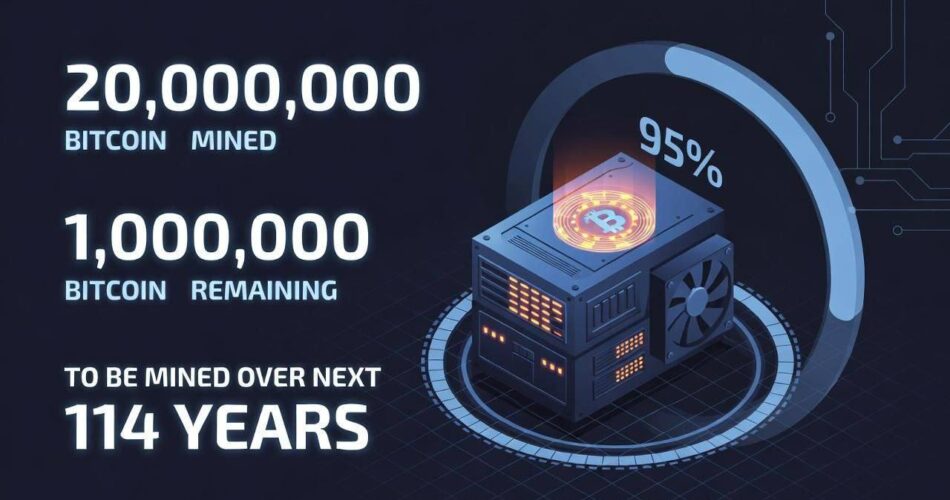

The 20 millionth Bitcoin milestone was reached in block 939999, mined by an unknown miner, leaving just one million coins to be issued until roughly the year 2140.
There are moments in crypto that feel routine while they’re happening, and then later you realize you just witnessed a piece of history. The mining of the 20 millionth Bitcoin is exactly one of those moments. No fireworks, no dramatic countdown broadcast on global television, no confetti falling over a trading floor. Just another block, another reward, another quiet step forward in the longest-running monetary experiment of the internet age.
And yet this milestone carries a strange weight.
Bitcoin has a hard cap of 21 million coins. That number isn’t marketing fluff or a promise from a central authority. It’s written directly into the protocol, enforced by every node, every miner, every participant in the network. When Satoshi Nakamoto launched Bitcoin in 2009, the emission schedule was already locked in: a slow, predictable release of coins through block rewards, gradually tapering off through halvings until the last satoshi is mined sometime around the year 2140.
Now we’ve crossed the 20 million mark.
That means more than 95% of all Bitcoin that will ever exist has already been mined.
What makes this moment even more interesting is the block itself. The milestone coin appeared in block 939999, and the miner responsible for it remains unknown. No public identity, no announcement, no claim of historic achievement. Just a miner somewhere in the global network quietly solving the proof-of-work puzzle and broadcasting the block to the chain.
In many ways, that anonymity feels perfectly aligned with the spirit of Bitcoin.
For miners, this milestone has a particularly emotional flavor. Mining isn’t just a technical process or a line in a balance sheet—it’s participation in the creation of digital scarcity. Every block is a tiny piece of history. Every reward is part of a schedule that cannot be rushed, negotiated, or changed without global consensus.
Think about how long it took to get here.
In the early days, Bitcoin mining looked almost comical by today’s standards. People mined on laptops and home PCs. A few hobbyists ran GPUs in their basements. The network hash rate was tiny compared to what we see now. Back then, nobody talked about industrial mining farms, immersion cooling, or megawatts of energy contracts.
Mining was curiosity.
Then it became a hobby.
Then it became a race.
And eventually it became an industry.
Today the global Bitcoin mining network is a massive organism. Warehouses full of ASICs hum across continents. Entire power infrastructures are built around mining operations. Pools coordinate the work of miners scattered across the planet, turning individual hash power into collective block discoveries.
Through all of that transformation, one thing never changed: the emission schedule.
Every 210,000 blocks, the block reward halves. What started at 50 BTC per block dropped to 25, then 12.5, then 6.25, and now we’re living in the era of 3.125 BTC after the latest halving. Each halving squeezes the supply tighter, making every new Bitcoin just a little bit harder to produce.
That slow tightening is exactly why the 20 million milestone feels different.
At the beginning, coins flowed into circulation relatively quickly. Millions of BTC were mined in the early years when the network was small. But now, each remaining coin will take longer and longer to appear.
The final one million Bitcoin will not arrive quickly. They’ll be stretched across more than a century.
Think about that for a moment.
Most of the miners reading this today will not be around to see the final satoshi mined. Neither will the current generation of hardware, mining companies, or maybe even the same political and economic systems we live under today.
Yet the protocol already knows the schedule.
It’s one of the most fascinating aspects of Bitcoin: time itself is embedded into the issuance curve. The network doesn’t care about market cycles, government policies, or macroeconomic panic. Blocks continue to arrive roughly every ten minutes, and the reward continues to decline according to a schedule written over a decade ago.
The mining of the 20 millionth Bitcoin reminds us how far the network has already traveled.
From an obscure whitepaper shared on a cryptography mailing list to a global financial asset with trillion-dollar discussions around it. From CPUs to ASICs. From a few curious developers to an entire ecosystem of miners, builders, traders, and believers.
And miners sit at the center of that story.
Without miners, Bitcoin isn’t just slower—it simply doesn’t function. Mining secures the chain, validates transactions, and enforces the rules of issuance. Every time a block is produced, miners collectively confirm that the protocol’s monetary policy remains intact.
No shortcuts. No inflation surprises. No sudden printing.
The fact that we now have only one million coins left to mine is proof that the system has worked exactly as designed.
But here’s the interesting twist: the closer we get to 21 million, the less mining will depend on block rewards.
In the distant future, transaction fees will become the primary incentive for miners. Instead of relying on newly minted coins, miners will be compensated by users who want their transactions included in blocks. The economics of mining will gradually shift from issuance-driven to fee-driven.
That transition is already slowly beginning.
We’ve seen periods where transaction fees spike dramatically during network congestion. When demand for block space rises, fees follow. It’s a small preview of how the network might sustain miners long after the block reward becomes tiny.
For mining pools like WoolyPooly and the wider mining community, this milestone isn’t just about Bitcoin’s past. It’s also a reminder of the long road ahead.
The next million coins will be mined slowly. Painfully slowly.
Each halving cuts rewards again. Each cycle forces miners to become more efficient, more creative, and more resilient. Hardware evolves, energy strategies evolve, and mining operations adapt to survive in an increasingly competitive environment.
But that’s always been the story of mining.
Pressure creates innovation.
The miners who remain after each cycle are the ones who learned how to survive the previous one.
Standing here at 20 million Bitcoin mined feels a bit like reaching a mountain ridge after a long climb. You turn around and see the valley you crossed—years of development, crashes, bull markets, hardware revolutions, and technological breakthroughs.
And ahead of you there’s still a long path.
One million coins.
A century of blocks.
Thousands of halvings still quietly ticking forward in the protocol’s clockwork.
Somewhere around the year 2140, a miner will discover the final block that includes the last satoshi ever created. No new Bitcoin will ever appear after that moment. The supply will be complete.
Nobody reading this today knows what the world will look like then.
But the schedule is already written.
And today’s milestone—the 20 millionth Bitcoin, quietly appearing in block 939999 from an unknown miner—feels like another confirmation that Bitcoin continues to do exactly what it promised from the very beginning.
Tick by block.