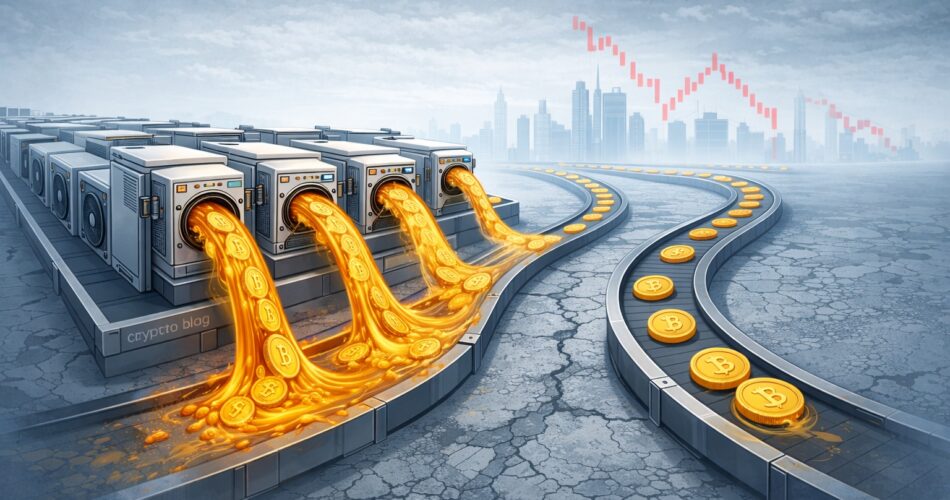

A quiet pivot is unfolding: big miners sell BTC, cut costs, and chase AI revenue as mining margins collapse in 2026.
Table of Contents
The end of HODL as a default strategy
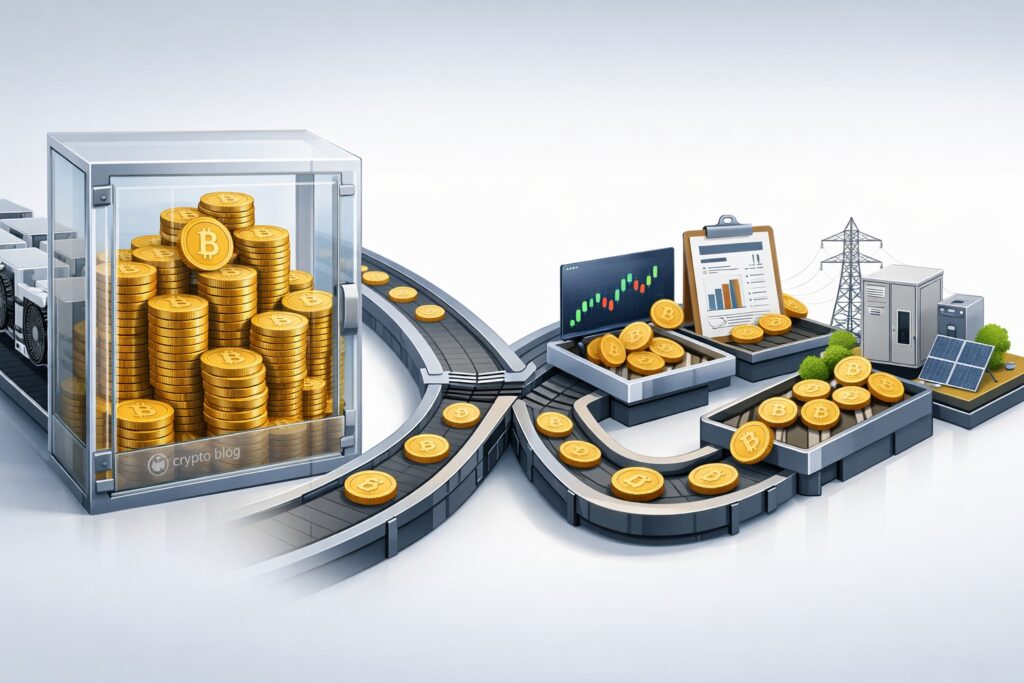
There’s a particular kind of silence you feel in mining when the numbers stop making sense. Not panic, not even fear—just a slow, creeping realization that the game you’ve been playing is changing shape right under your feet. That’s exactly where we are now in early April 2026.
For years, the identity of a serious Bitcoin miner was simple: accumulate, hold, expand. The classic HODL narrative wasn’t just ideology—it was strategy. Stack BTC, survive volatility, and let time do the rest. But over the past few weeks, watching what the largest public miners are doing, it’s clear that this era is fading.
And the shift isn’t subtle—it’s measurable.
Public mining companies have collectively reduced reserves by more than 15,000 BTC in recent months. That’s not rebalancing. That’s a coordinated shift in behavior.
And once you notice it, you can’t unsee it.
Selling Bitcoin is no longer a red flag
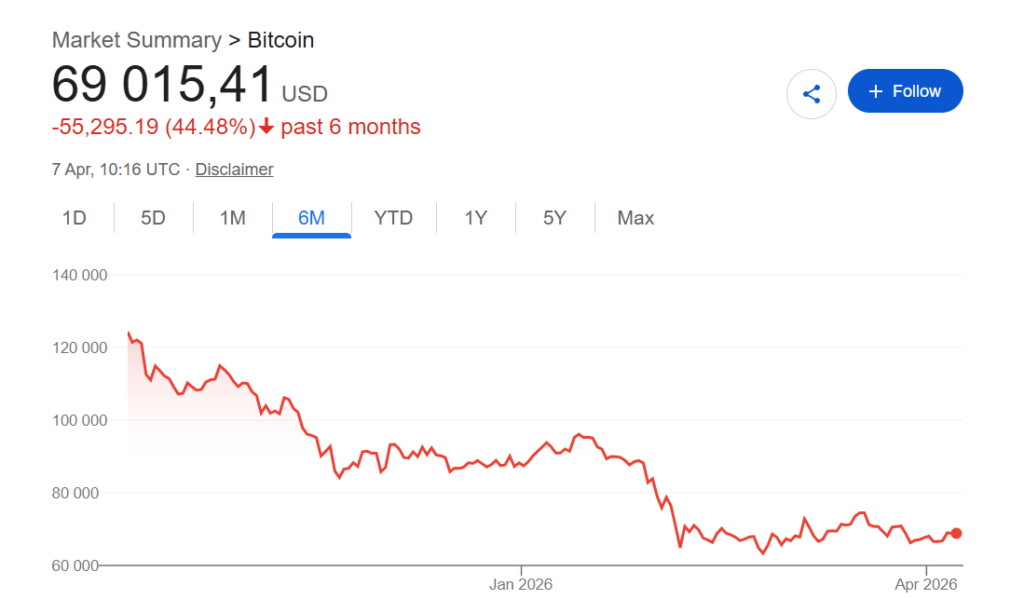
Let’s talk specifics—because the numbers here matter.
MARA Holdings sold 15,133 BTC between March 4 and March 25, 2026, raising roughly $1.1 billion. This wasn’t panic selling. It was calculated: the funds were used to repurchase convertible senior notes due in 2030 and 2031 at about a 9% discount, cutting total convertible debt from around $3.3 billion to $2.3 billion.
That’s a 30% reduction in debt—paid for with Bitcoin.
After the sale, MARA still holds 38,689 BTC, but that’s a 28% drop in reserves. And almost simultaneously, they initiated layoffs—about 15% of staff (roughly 40 employees), signaling a broader restructuring.
Now look at Riot Platforms.
In Q1 2026, Riot mined 1,473 BTC—but sold 3,778 BTC, generating $289.5 million at an average price of around $76,600 per BTC. That’s more than 2.5× their production.
Their remaining reserves? 15,680 BTC, down 18% year-over-year, with 5,802 BTC pledged as collateral.
This is not “hold at all costs.” This is active treasury management.
And across the industry, we’ve seen similar behavior:
- Core Scientific sold around 1,900 BTC earlier this year
- Bitdeer reduced reserves to effectively zero in February
Bitcoin is no longer sacred inventory. It’s liquidity.
Why the numbers stopped working
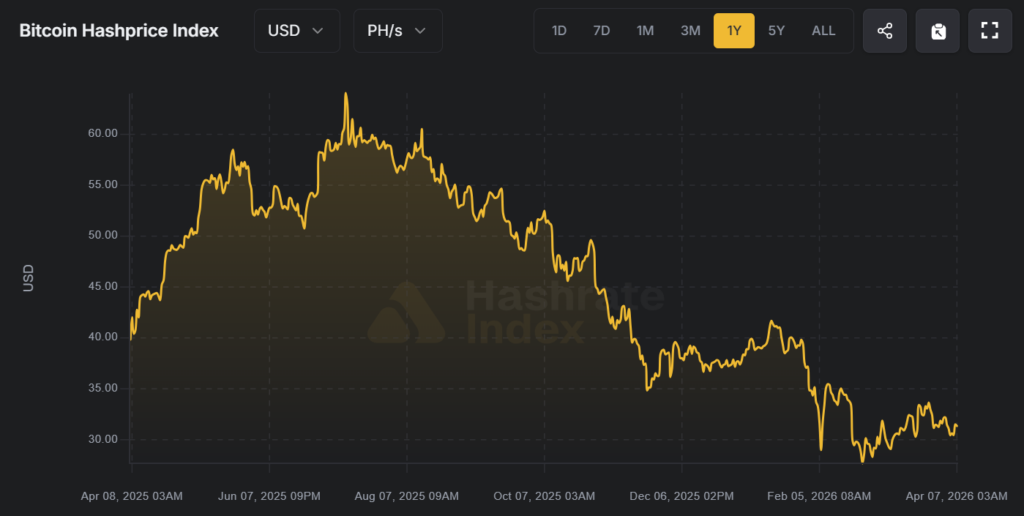
If you want to understand why this is happening, you don’t need narratives—you need math.
Hashprice has collapsed.
- ~$63/PH/s/day in July 2025
- ~$36–38 by late 2025
- ~$28–30 in early March 2026
That’s a drop of more than 50% in under a year, landing us at a five-year low.
At the same time, costs haven’t cooperated.
Average cash cost for public miners is now around $80,000 per BTC, while market prices in March–April hover around $67k–70k. That means some operations are effectively losing up to $19,000 per coin mined.
And here’s where it gets brutal: roughly 15–20% of older hardware is now economically obsolete—especially for miners paying ≥6¢/kWh.
Even the positives feel muted.
Yes, network hashrate saw its first quarterly decline in six years in Q1 2026. Yes, difficulty adjusted downward slightly. But overall network pressure remains high.
And transaction fees? Still contributing less than 1% of block rewards.
So the equation becomes unavoidable:
You can mine… or you can survive. Doing both is no longer guaranteed.
The quiet move toward AI and HPC
Now shift your focus from what miners are selling to what they’re building.
This is where the story gets even more interesting.
Public miners are aggressively pivoting toward AI and high-performance computing (HPC), leveraging their core advantages: energy access, land, and data center infrastructure.
The scale is massive.
Across the sector, announced AI/HPC capacity projects now total roughly 21 gigawatts. That’s not experimentation—that’s industrial repositioning.
And the revenue mix is already shifting.
Today, some miners generate around 30% of revenue from AI-related services. By the end of 2026, projections suggest that figure could rise to 70% for certain players.
Why?
Because AI offers something mining doesn’t:
- predictable, contract-based income
- higher and more stable margins
- long-term agreements with hyperscalers
Meanwhile, Riot has already been expanding data centers tied to AI/HPC colocation, while also growing its mining capacity to 42.5 EH/s—a 26% increase—and reducing energy cost to around 3.0¢/kWh thanks to credits.
It’s a dual strategy: scale mining where efficient, and redirect capital where returns are steadier.
Layoffs, efficiency, and the new mining reality
When margins shrink, everything gets sharper.
MARA’s 15% workforce reduction isn’t just a cost-saving move—it’s part of a broader reset. Employees were given structured exit packages, including one month of paid leave and 13 weeks of severance, which tells you this wasn’t reactive—it was planned.
This is what discipline looks like in a compressed market.
Mining is no longer about who can grow fastest. It’s about who can operate leanest.
The new rules are simple:
- energy below 4–5¢/kWh is no longer optional—it’s survival
- outdated ASICs are liabilities, not assets
- capital efficiency matters more than scale
And perhaps most importantly: flexibility beats ideology.
What this means for mining pools
For pools, this shift changes the flow of hashrate itself.
Public miners currently control over 40%+ of global hashrate, so when they:
- sell BTC aggressively
- shut down inefficient machines
- redirect infrastructure toward AI
…it creates ripple effects across the entire network.
We’re already seeing early signs:
- hashrate redistribution
- temporary declines in network power
- increased volatility in pool contributions
This is where mining pools need to adapt.
Miners—especially mid-sized and smaller ones—are becoming more selective. They’re looking for:
- consistent, predictable payouts
- low and transparent fees
- strong uptime and infrastructure
- support for alternative PoW coins
Because in uncertain conditions, stability becomes the product.
A window of opportunity for smaller miners
Here’s the part that feels almost counterintuitive.
When giants step back, even slightly, space opens up.
The decline in hashrate and subsequent difficulty adjustments create breathing room. Not a massive one—but enough for efficient operators to capture more rewards.
And timing matters.
After winter shutdowns and early-year pressure, April 2026 is already showing signs of partial recovery in mining profit. Not a full rebound—but a shift.
The winners in this window are clear:
- miners with electricity costs below 4¢/kWh
- operators running next-gen ASICs
- setups that can quickly adapt to market changes
For them, this isn’t just survival—it’s opportunity.
Beyond Bitcoin: diversification returns
At the same time, there’s a subtle shift happening outside Bitcoin.
GPU mining is quietly becoming relevant again—not as a hype cycle, but as a tactical move. When BTC margins compress this much, attention naturally spreads.
Coins like CFX and other niche PoW networks are gaining traction—not because they’re guaranteed winners, but because they offer alternative economics.
For smaller miners, this isn’t about abandoning Bitcoin.
It’s about optionality.
And in 2026, optionality is one of the most valuable assets you can have.
So… is this a crisis or a transition?
It’s easy to look at this moment and see only pressure:
- BTC reserves dropping by tens of thousands
- companies selling more than they mine
- layoffs and restructuring
- margins squeezed to the edge
But that’s only half the story.
What we’re actually witnessing is a structural transition.
From HODL to liquidity.
From mining-only to hybrid infrastructure.
From growth-at-all-costs to capital efficiency.
Bitcoin mining isn’t dying.
It’s maturing.
And like every maturation process, it’s uncomfortable, uneven, and full of hard decisions.
The real question now isn’t whether the industry survives.
It’s who adapts fast enough to survive with it.
Linksman.