
BGIN’s 4nm chip and HIVE’s AI pivot show mining dividing: efficiency rises, while flexibility becomes the edge for smaller players.
Table of Contents
The moment that quietly changed the tone
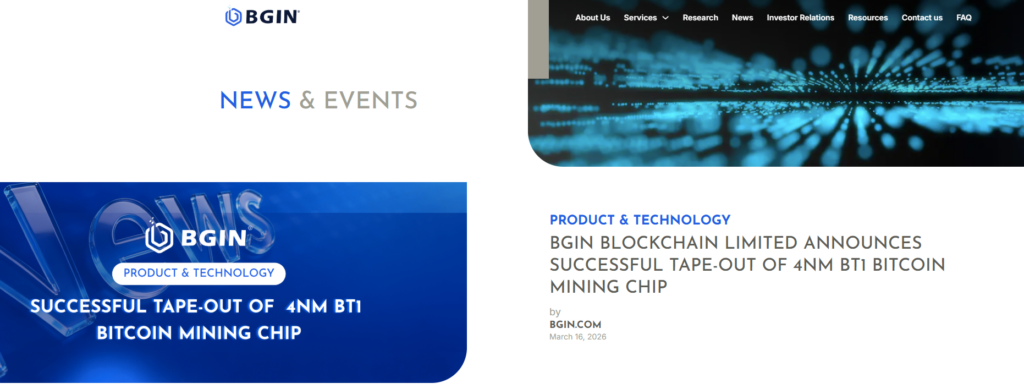
Yesterday didn’t feel dramatic, but for anyone who lives inside mining cycles, it carried weight. BGIN confirmed that its 4nm Bitcoin ASIC, BT1, achieved successful first-pass silicon, and that detail alone says more than most press releases ever could. In hardware, first-pass success is rare. It means no costly redesigns, no months lost fixing mistakes, and no uncertainty about whether the chip will actually perform as intended. It means the roadmap is real, not theoretical.
There’s also a psychological layer to it. When a company consistently delivers working silicon on the first attempt — and this is already their seventh successful tape-out since 2022 — the market starts treating them differently. They stop being “a newcomer” and start becoming “a factor.” That shift doesn’t happen overnight, but moments like this accelerate it.
Why 4nm actually matters
It’s easy to say “4nm is better than 5nm,” but in mining, that gap translates into something very concrete: survival margins. Smaller process nodes typically mean better energy efficiency, and in Bitcoin mining, efficiency is everything. Lower joules per terahash can be the difference between operating profitably and running at a loss when network difficulty rises or Bitcoin price stalls.
Right now, most of the industry is still operating within the 5–7nm generation. That means a successful 4nm chip isn’t just incremental progress — it’s a step ahead of the current baseline. Even without exact specifications like TH/s or W/TH, the direction is clear. If BGIN delivers competitive machines on top of this chip, we’re looking at a new efficiency benchmark entering the market.
And when a new benchmark appears, it doesn’t stay isolated. It spreads. Competitors react. Expectations shift. Older hardware ages faster than expected. The entire network gradually recalibrates around a new level of efficiency.
A new player in a familiar game
For years, the ASIC market has been dominated by a small group: Bitmain, MicroBT, Canaan. It’s been a closed loop where innovation happens, but within predictable boundaries. You knew who was building the next generation, and roughly what it would look like.
BGIN entering with a 4nm ASIC breaks that pattern. Not because they instantly take over, but because they introduce uncertainty into a previously stable structure. And uncertainty in hardware markets often leads to one thing: competition.
Competition can mean better pricing. It can mean faster innovation cycles. It can also mean more aggressive positioning from established players trying to defend their share. For miners, especially those planning hardware upgrades in 2026, this matters more than it might seem at first glance.
At the same time, miners are looking elsewhere
While hardware is pushing forward, another trend is unfolding in parallel — and it almost feels contradictory. Companies that built their identity around Bitcoin mining are increasingly exploring, or even prioritizing, AI infrastructure.
HIVE is one of the clearest examples. The company is gradually reducing its Bitcoin mining exposure in Sweden while expanding AI and HPC operations in Canada, scaling capacity from around 4 MW to over 16 MW through its BUZZ HPC initiative. The goal of reaching roughly $200 million in annual AI revenue isn’t framed as a side experiment. It’s positioned as a strategic direction.
And HIVE isn’t alone. MARA, CleanSpark, Bit Digital — the list keeps growing. Some are testing the waters, others are already moving deeper. The common thread is simple: AI workloads offer different economics.
Why AI is pulling attention
Bitcoin mining is one of the most optimized industries in crypto. Over the years, inefficiencies have been squeezed out. Margins have tightened. The game has become predictable, and in many ways, that predictability limits upside.
AI is the opposite. It’s still evolving, still inefficient, still full of gaps that can be monetized. Demand is growing faster than infrastructure can keep up, and that imbalance creates opportunity. Where Bitcoin mining rewards precision and scale, AI often rewards early positioning and flexibility.
For large public companies, this creates a natural incentive to diversify. If you already have data centers, power agreements, and operational expertise, shifting part of your capacity toward AI can unlock new revenue streams without abandoning your core entirely.
What this means for Bitcoin mining
Put these two trends together — more efficient hardware and capital drifting toward AI — and you get a market that’s becoming more polarized. On one side, Bitcoin mining continues to evolve into a highly efficient, capital-intensive industry. On the other, alternative uses of infrastructure are attracting attention and investment.
For smaller miners, this changes the equation. Bitcoin is not disappearing, but it is becoming less forgiving. The margin for error shrinks with every hardware generation. Access to top-tier ASICs and cheap electricity becomes less of an advantage and more of a requirement.
When a new chip like BGIN’s BT1 enters the market, it doesn’t just improve efficiency for those who adopt it. It increases pressure on everyone who doesn’t.
The overlooked advantage: flexibility
This is where the story takes a turn that doesn’t get enough attention. While large players optimize or pivot, smaller miners still have something powerful: flexibility.
You’re not locked into massive, single-purpose infrastructure. You’re not forced to justify billion-dollar investments. You can move between coins, adapt to market conditions, and react faster than larger operations.
Altcoins like Kaspa, Ergo, Ravencoin, and Conflux continue to offer opportunities precisely because they are less saturated and less optimized than Bitcoin. Their economics are different, their cycles are different, and their competition is different.
That difference is where flexibility becomes an advantage instead of a limitation.
Where WoolyPooly fits into this shift
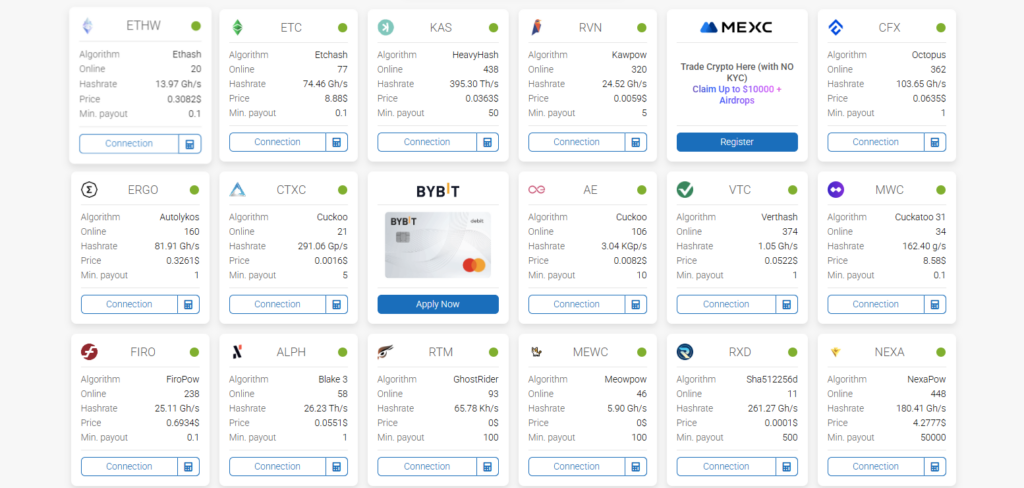
This is exactly the environment where WoolyPooly has always felt at home. The idea was never to tie miners to a single coin or a single narrative. Markets shift too quickly for that approach to hold over time.
Supporting a wide range of coins isn’t just about variety — it’s about giving miners the ability to adapt. When one coin becomes less profitable, you don’t wait. You switch. When conditions change, you adjust. That responsiveness is what keeps operations sustainable in a market that doesn’t stand still.
Low fees and fast payouts matter, of course. So does a clean and reliable interface. But the deeper value is optionality — the ability to make decisions based on current conditions rather than being locked into yesterday’s strategy.
The real takeaway for 2026
If you zoom out, 2026 is shaping up to be less about a single dominant trend and more about divergence. Bitcoin mining is becoming more efficient and more demanding at the same time. AI is emerging as a parallel path that attracts capital and attention. And between these two forces, there’s a wide space where independent miners can still operate effectively.
BGIN’s 4nm ASIC is not just another chip release. It’s a signal that the efficiency race is accelerating. HIVE’s pivot is not just a business decision. It’s a signal that even established players are rethinking where growth comes from.
The industry isn’t collapsing or slowing down. It’s splitting into different directions.
And in a landscape like that, success doesn’t come from following a single path. It comes from knowing when to stay, when to move, and when to rethink the entire strategy.