

Oil surging past $100 scares markets, but a new Luxor analysis suggests most Bitcoin miners barely feel it. The real risk lies elsewhere.
Table of Contents
The first thing you notice when oil starts flirting with $100 a barrel is the panic. It spreads quickly. Traders get nervous, headlines turn dramatic, and suddenly every industry that consumes energy is placed under a microscope. Crypto mining always ends up somewhere near the top of that list. I’ve seen it happen over and over again in this space. The moment oil spikes, people assume mining economics are about to implode.
But the interesting thing about the current situation in 2026 is that the story everyone expects simply isn’t playing out.
The latest analysis from Luxor’s Hashrate Index — published just yesterday and already circulating through the mining community — puts some numbers behind what many operators have been quietly observing for years. Despite the global attention on oil prices, only about 8–10% of the total Bitcoin hashrate actually runs in regions where electricity prices are directly tied to oil.
Let that sink in for a moment.
The overwhelming majority of the network — roughly 90% of global mining power — runs on energy sources whose pricing is not strongly connected to crude oil at all.
And that changes the entire conversation.
The Myth That Oil Controls Mining
For years, the narrative around Bitcoin mining energy costs was simple: higher oil prices mean higher electricity prices, and higher electricity prices mean miners suffer.
It sounds logical, but the mining world has evolved.
Large mining operations today rely on a completely different mix of energy sources. Gas, coal, hydroelectric power, nuclear energy, and increasingly renewables dominate the landscape. These energy markets behave differently than oil markets. Their pricing mechanisms are regional, regulated, or tied to long-term contracts rather than daily commodity volatility.
Hydroelectric plants in Canada don’t suddenly charge more because tankers are under threat in the Strait of Hormuz. Nuclear plants in Europe aren’t adjusting output based on Brent futures.
Mining has gradually migrated toward energy stability.
That migration didn’t happen overnight. It was the result of years of miners chasing the lowest and most predictable electricity costs available. Cheap power has always been the core competitive advantage in this industry, and operators have become incredibly sophisticated in finding it.
What Luxor’s report really confirms is something we’ve seen quietly unfold since the early 2020s: Bitcoin mining has structurally decoupled from oil.
The Geography of Hashrate
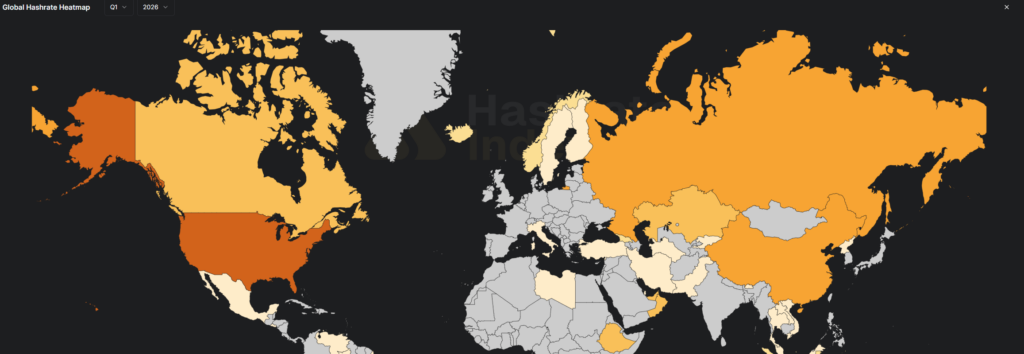
To understand why oil doesn’t move the needle much anymore, you have to look at where the network actually lives.
Mining is no longer concentrated in a few regions with volatile energy costs. Instead, it’s distributed across countries where power generation comes from diverse sources.
North America alone hosts a massive portion of the network. Texas gas infrastructure, Canadian hydroelectric dams, and increasingly large renewable installations form the backbone of many operations.
Central Asia contributes a meaningful share with coal and hydro.
Parts of Scandinavia leverage surplus hydroelectric capacity.
Even in places like Latin America, miners are tapping into stranded hydro and geothermal energy that would otherwise go unused.
The regions where electricity prices track oil closely — parts of the Middle East such as the UAE, Oman, Kuwait, and a handful of others — simply represent a small slice of the global hashrate pie.
That slice matters, but it isn’t large enough to shake the entire network when oil moves.
So when crude climbs toward $100, most miners around the world barely notice.
Their electricity bill next month will look almost identical to the one they paid last month.
The Real Risk Nobody Talks About
Here’s where the conversation gets interesting.
While oil doesn’t hit miners directly through electricity costs, it can still affect them — just through a completely different mechanism.
Revenue.
If you’ve been around mining long enough, you know that the revenue side of the equation matters far more than the cost side during macro shocks.
Right now the biggest threat to miners isn’t oil. It’s what oil does to the global economy.
When energy prices surge, inflation pressures return. When inflation rises, central banks become cautious about cutting interest rates. And when rate cuts get delayed, risk assets tend to struggle.
Bitcoin still lives inside that macro environment.
So the chain reaction looks something like this:
Oil spike → inflation concerns → slower monetary easing → pressure on risk assets → Bitcoin price volatility.
And if Bitcoin falls, mining revenue falls with it.
Not because electricity got expensive, but because the asset being mined is worth less.
Hashprice Is the Metric That Matters
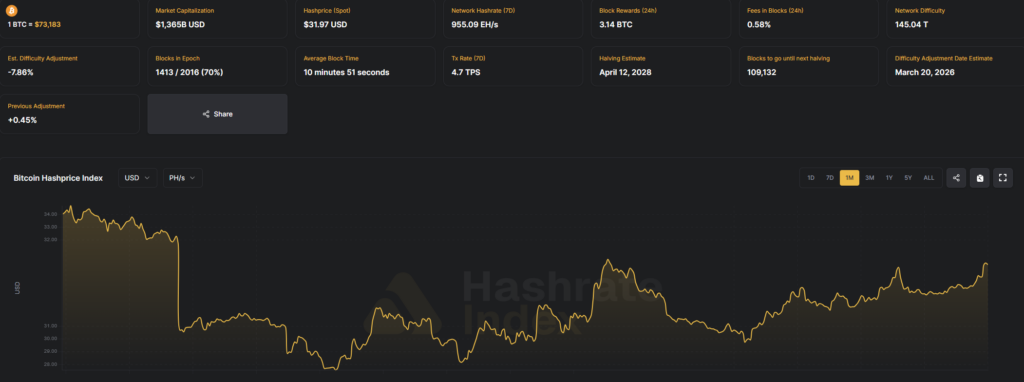
Inside mining circles, the metric everyone watches during times like this is hashprice — the daily revenue a miner earns per unit of hashpower.
Hashprice compresses when either:
- Bitcoin’s price drops
- Network difficulty rises
- Transaction fees decline
Or some combination of the three.
Right now hashprice is hovering roughly around the $29–30 per PH/s per day range, depending on the exact market conditions. That’s not catastrophic, but it’s not exactly the golden era either.
Mining margins have been tightening gradually since the last halving. Operators with efficient hardware and cheap electricity are doing fine, but the days of effortless profitability are long gone.
That’s why miners pay far more attention to BTC price trends than to oil markets.
A sudden drop in Bitcoin from $70k toward $55k would hurt the industry far more than oil climbing from $90 to $110.
Why Bitcoin Is Holding Up Surprisingly Well
Another fascinating aspect of the current moment is that Bitcoin has shown remarkable resilience despite the geopolitical tension pushing oil upward.
In past macro shocks, crypto markets often reacted quickly and violently. Liquidity would vanish, traders would go risk-off, and Bitcoin would slide.
But today BTC is still hovering around $70,000, even as Brent and WTI flirt with the $100 mark.
That’s not something you could have confidently predicted five or six years ago.
Part of this resilience likely comes from the structural maturity of the market. Institutional flows, ETFs, and deeper liquidity have changed how Bitcoin behaves during global turbulence.
It’s no longer just a speculative playground reacting to every headline.
For miners, that stability is quietly reassuring.
As long as BTC holds its ground, the economics of the network remain intact.
What Smart Miners Are Doing in 2026
If you talk to experienced operators today, you’ll notice something interesting about their strategy.
Very few are relying on a single revenue stream anymore.
The mining industry has become more flexible, more opportunistic, and frankly more creative than it used to be. Hardware can shift between algorithms. Infrastructure can pivot toward different coins when economics change.
That adaptability is the real survival skill in 2026.
Because the truth is simple: Bitcoin cycles are inevitable.
Hashprice expands, then compresses. Difficulty rises. Hardware gets replaced. Profit margins tighten and loosen again.
Miners who survive multiple cycles rarely bet everything on one outcome.
Instead, they diversify.
Some allocate part of their hashrate to alternative networks. Others explore privacy-focused coins, AI-adjacent projects, or emerging proof-of-work ecosystems where competition is lower and early rewards are higher.
It’s less about abandoning Bitcoin and more about building a buffer against volatility.
Pools Matter More During Volatility
Another piece of the puzzle — often overlooked by newcomers — is the role mining pools play during uncertain times.
When markets are stable, pool choice can feel like a minor detail.
But during volatility, reliability suddenly becomes extremely important.
Consistent payouts, low fees, stable infrastructure, and transparent statistics can make a real difference in a miner’s daily economics. Even small efficiency improvements compound over time.
That’s one of the reasons many miners prefer working with pools that support multiple coins and algorithms.
Flexibility matters.
Being able to switch strategies quickly — without rebuilding your entire setup — is a powerful advantage.
Why Diversification Isn’t Just a Buzzword
The word “diversification” gets thrown around a lot in crypto, sometimes to the point where it loses meaning.
But in mining, diversification isn’t theoretical.
It’s practical.
When Bitcoin difficulty surges or hashprice compresses, having the ability to allocate rigs to other profitable networks can smooth income dramatically. Even small differences in profitability across coins can add up across large hashrate deployments.
And sometimes, those alternative networks end up becoming tomorrow’s major ecosystems.
Mining has always been partly about exploration.
You never know which project will evolve into the next major proof-of-work community.
The Bigger Picture
Looking at the current oil headlines from a distance, the takeaway is surprisingly calm.
Yes, geopolitics is tense. Yes, oil markets are volatile. And yes, macro uncertainty always introduces new risks.
But the core economics of Bitcoin mining are far more resilient than many outsiders assume.
Electricity diversification, global hashrate distribution, and more mature infrastructure have made the network less sensitive to commodity shocks.
In other words, mining is no longer the fragile experiment people once believed it to be.
It’s an industry.
A tough one, a competitive one, and sometimes a chaotic one — but an industry that has learned how to survive.
Mine Smart, Not Just Hard
If there’s one lesson worth remembering during moments like this, it’s that successful miners rarely panic when headlines get loud.
They watch the numbers.
They watch hashprice.
They watch network difficulty.
And they stay flexible enough to adapt when conditions change.
Because in the end, surviving the cycles has always been the real game.
Markets will move. Oil will spike. Narratives will change. But miners who stay efficient, diversified, and connected to strong infrastructure tend to keep going long after the panic fades.
And in this industry, endurance is everything.