

Table of Contents
A historic milestone — and a warning for miners
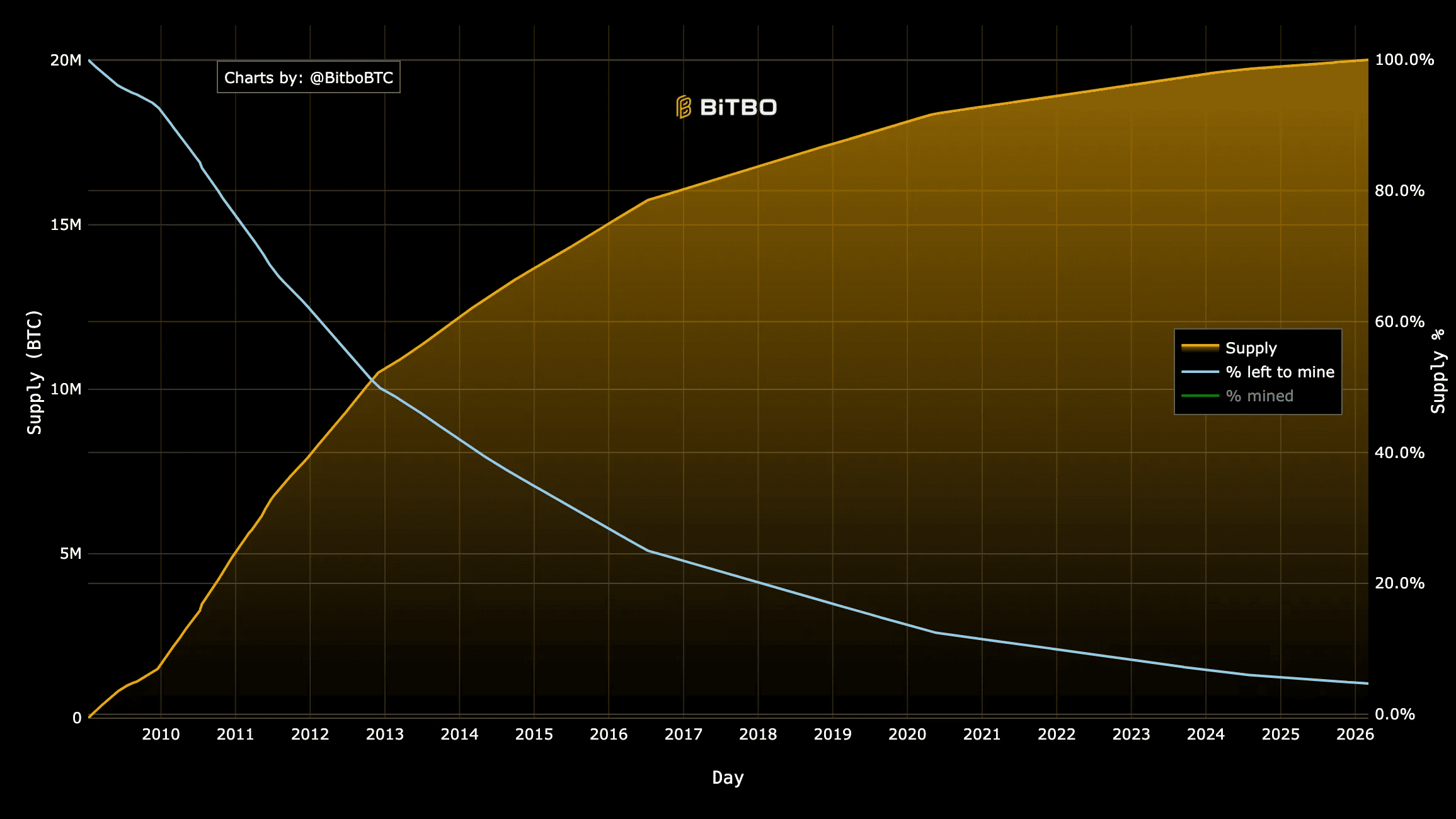
On March 11, 2026, Bitcoin quietly crossed one of the most important milestones in its history.
More than 20 million BTC have now been mined, leaving less than one million coins before the network reaches its hard cap of 21 million Bitcoin.
At first glance, the milestone sounds bullish. Bitcoin scarcity is one of the main reasons the asset has grown into a trillion-dollar market over the years. But behind this symbolic moment, the economics of mining are becoming increasingly complex.
At the same time this milestone was reached, two important announcements emerged within days of each other.
First, Leo Wang, Vice President at Canaan, one of the world’s largest ASIC manufacturers, suggested that the industry might be approaching the last truly explosive bull cycle for Bitcoin miners.
Second, Foundry — the operator of the world’s largest Bitcoin mining pool — announced plans to launch an institutional mining pool for Zcash, scheduled for April 2026.
Taken together, these developments reveal a deeper trend inside the mining industry:
the era of relying on a single PoW asset may be ending.
For miners — from small GPU rigs to large farms — the message is becoming increasingly clear: adaptability and diversification are becoming essential.
Why some industry leaders think the “golden age” of Bitcoin mining may be ending

In a recent interview discussing the future of mining economics, Leo Wang of Canaan made a statement that caught the attention of many miners.
He suggested that after the 2028 Bitcoin halving, miners may no longer experience the same explosive profitability cycles that characterized previous years.
His reasoning is grounded in several long-term trends shaping the industry.
1. Block rewards continue to shrink
Bitcoin’s monetary policy is fixed. Every four years the network undergoes a halving, reducing the block reward paid to miners.
- 2020 reward: 6.25 BTC
- 2024 reward: 3.125 BTC
- Expected 2028 reward: 1.5625 BTC
Each halving makes mining revenue increasingly dependent on transaction fees and price appreciation rather than block rewards alone.
2. Global hashrate keeps climbing

The Bitcoin network hashrate continues to grow as more industrial-scale mining operations come online.
New ASIC generations are deployed every year, and large mining companies continue expanding infrastructure in regions with cheap power.
While this strengthens the network, it also means:
- higher mining difficulty
- thinner profit margins
- faster hardware obsolescence
For smaller miners, the competition has never been tougher.
3. Energy costs and infrastructure are rising
Electricity has always been the largest operational expense for miners. But global energy markets have become more volatile, and new data centers require increasingly sophisticated cooling and power management systems.
Large public mining companies such as Riot Platforms, Marathon Digital, and CleanSpark are investing heavily in infrastructure — and some are even shifting part of their capacity toward AI and high-performance computing workloads.
This shift highlights a broader trend:
mining companies are increasingly diversifying revenue sources.
Why Foundry’s move into Zcash is significant

Almost simultaneously with the Canaan interview, another piece of news caught the attention of the mining community.
Foundry, the operator of the largest Bitcoin mining pool in the world, announced plans to launch a new institutional mining pool for Zcash (ZEC) in April 2026.
The pool will focus on:
- regulatory compliance
- institutional-grade infrastructure
- enterprise-level mining operations
According to the announcement, the new service will provide “compliance-first infrastructure built by the team behind the world’s #1 Bitcoin mining pool.”
This is notable for several reasons.
Even the largest Bitcoin pool is diversifying
Foundry’s decision suggests that diversification is not just a strategy for smaller miners.
When the largest BTC mining pool expands into another Proof-of-Work network, it sends a signal:
relying solely on Bitcoin mining may no longer be the optimal strategy for everyone.
Zcash remains one of the major GPU-mined networks
Unlike Bitcoin, which is dominated by ASIC hardware, Zcash still provides opportunities for miners operating GPU-based infrastructure.
Its hashrate remains significantly lower than Bitcoin’s, which means:
- competition can be less intense
- entry barriers are lower
- profitability can fluctuate depending on market conditions
For miners looking to diversify their hashrate allocation, networks like Zcash remain an important part of the ecosystem.
The strategy miners are increasingly adopting
The mining industry is not disappearing. But its structure is evolving.
Many experienced miners today are moving toward a multi-coin strategy.
Instead of pointing all their hardware to a single network, they distribute hashrate across several Proof-of-Work coins.
Typical setups may include:
- Bitcoin for long-term stability
- alternative PoW networks for higher short-term profitability
- opportunistic switching depending on market conditions
This approach helps miners:
- smooth revenue fluctuations
- reduce risk from difficulty spikes
- react faster to changing market dynamics
In an environment where margins are tighter than they were during previous bull cycles, flexibility can become a significant advantage.
Why diversification tools matter more than ever
For miners who want to experiment with different networks, infrastructure becomes important.
Mining pools that support multiple coins, transparent statistics, and fast payouts allow miners to test strategies without complex configuration changes.
Platforms like WoolyPooly already support dozens of Proof-of-Work networks, allowing miners to:
- switch between coins easily
- monitor profitability
- test diversification strategies in real time
Instead of waiting for large institutional services to launch new pools months later, miners can experiment today and compare real-world results.
The next decade of mining will belong to adaptive miners
The milestone of 20 million mined Bitcoin marks an important moment in the network’s history.
But it also highlights a deeper reality.
Bitcoin mining is becoming more competitive, more capital-intensive, and more dependent on efficiency than ever before.
The miners who succeed in the coming decade will likely be those who:
- optimize energy usage
- upgrade hardware strategically
- monitor market profitability
- and diversify across multiple Proof-of-Work networks when necessary
Bitcoin mining is not ending.
But the era of easy profitability from a single coin may be gradually fading.
For miners willing to adapt, however, the industry still offers significant opportunities — especially for those ready to explore multiple networks and evolving mining strategies.